
Speaking and communicating are two different problems.
A child can recite every dinosaur in order and still be unable to tell a teacher they feel sick, follow the thread of a story, or answer “what did you do today?”. Our speech-language pathologists work across the whole span:
Hearing the pieces of words
Picking out and moving around the individual sounds and syllables inside a word, and making sense of what the ear takes in. This layer sits underneath both talking and reading.
Reading and understanding
Getting ready to read, building vocabulary, and pulling meaning off a page. A comprehension gap almost always looks like a behavior problem first, long before anyone calls it a language problem.
Writing and organizing
Sentence structure, grammar and getting thoughts into an order that survives being written down, so homework stops being a two-hour fight.
Clarity of speech
We treat sound production when it is genuinely getting in the way of being understood by teachers and classmates. Being understood is the bar, not sounding like anybody in particular.
We give them a way to be understood now, not later.
Waiting for speech while a child has no way to make themselves understood is how frustration turns into screaming, hitting and bolting. So we build something that works today: pointing and signing, a book of pictures, or a tablet that speaks for them, whatever gets a message out of your child's head and into the room fastest.
The fear worth naming out loud: giving a child a device does not take their voice away. In practice, a child who can finally be understood tends to get less frustrated and more interested in communicating, and that is the ground speech grows out of, not a substitute for it.
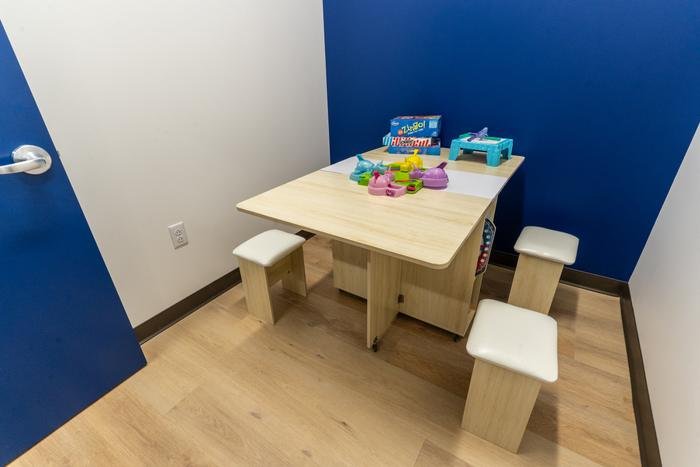
When food is the fight.
Some speech-language pathologists carry additional training in feeding and swallowing for autistic children. Where one of ours does, they will look at what is actually driving it: a texture the mouth refuses, weak oral-motor control, a diet that has narrowed to four beige foods, or a genuine safety concern about swallowing, and write a plan for it.
Feeding work runs alongside the ABA team's eating goals and, where sensory defensiveness is the cause, with occupational therapy. That is exactly the kind of tangle that unravels faster when all three clinicians are down the same hallway.
Ages: up to 18 years
Format: individual sessions, in center
Covers: clarity, language, literacy, devices and picture systems, feeding
Referral: some plans want one from your pediatrician, the benefits check tells us
Speech is authorized separately
Speech therapy appears in the Texas autism coverage statute for many plans, but it usually carries its own visit cap and its own approval, apart from ABA.
See how coverage works